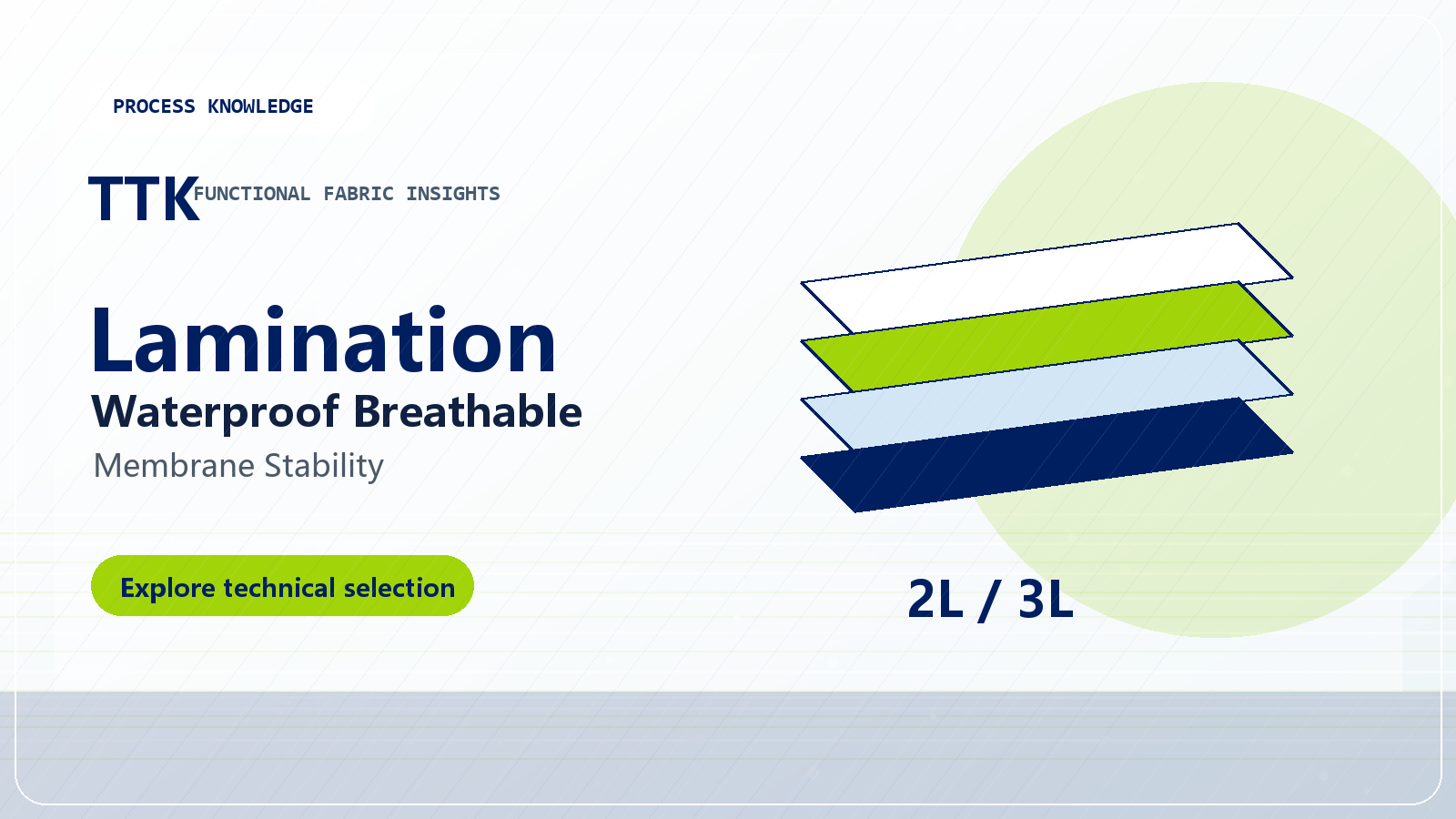
Short answer: when buyers need clearer waterproof-breathable targets, lamination usually creates a more stable performance boundary than coating alone.
Key Takeaways
- The membrane defines the core waterproof-breathable route, while the base fabric shapes hand feel and appearance.
- Adhesive and lamination conditions affect peel strength, breathability and wash durability.
- 2-layer, 2.5-layer and 3-layer structures suit different product positions.
What lamination solves
The challenge in waterproof-breathable fabric is to block external liquid water while allowing body moisture vapor to escape. Lamination uses a membrane as the stable barrier, then relies on fabric and adhesive system for wearing and manufacturing performance.
Compared with coating alone, a membrane route makes hydrostatic pressure, moisture permeability and durability targets easier to define. It suits shell jackets, cycling outerwear, ski apparel and light protection.
Indicators to evaluate
Key indicators include hydrostatic pressure, moisture vapor transmission, peel strength, post-wash performance, hand feel, noise, weight and dimensional stability. Different buyers prioritize different metrics, so one standard cannot judge all projects.
For cycling and hiking, breathability, light weight and low noise are important. For long rain or snow exposure, hydrostatic pressure, peel strength and durability matter more.
TTK process recommendation
Define the end use and layer structure first, then match base fabric, membrane and adhesive system. During sampling, test both initial and post-wash performance to avoid over-relying on first-round data.
TTK Recommendation
Lamination helps turn waterproof-breathable requirements into a testable, communicable and scalable fabric solution.
FAQ
Is lamination always better than coating?
Not always. Higher waterproof-breathable targets often suit lamination, while general protection or cost-sensitive projects may suit coating.
Why is peel strength important?
Peel strength affects structural stability during washing, wearing, sewing and long-term use.
Next Step
TTK can support development of 2-layer, 2.5-layer and 3-layer waterproof-breathable laminated fabrics.